

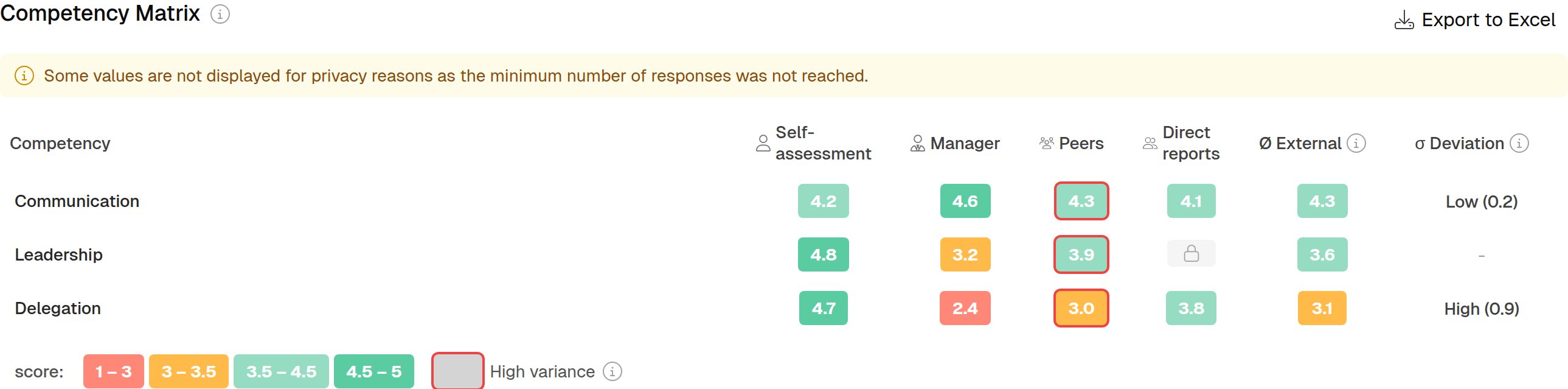
- All scores in the matrix are shown on the questionnaire’s scale (for example 1–5 or 1–10) and rounded to one decimal place.
- Ø External never includes your Self-assessment.
- σ Deviation is intentionally hidden whenever a perspective in that row is anonymity-restricted, so you never see a deviation calculated from an incomplete picture.
- Within-group deviation (the ring around a cell) is only calculated once a perspective has at least 6 distinct raters.
- Takes every response from that perspective to a question that belongs to the dimension.
- Converts each response to a value on the questionnaire’s scale. This step makes different question types — stars, smileys, NPS, ranked select — comparable.
- Averages those values.
- Rounds to one decimal place.
What happens when reviewers skip questions?
A question in a 360° questionnaire is optional unless its Required toggle is switched on — and new questions are optional by default. Reviewers can leave an optional question blank and still submit their feedback. This is what a skipped question does:- The missing answer counts nowhere. It is not treated as zero or as the lowest score.
- Everything else that person answered counts as normal. Their other responses feed into their dimensions’ scores as usual. Nobody is dropped from the results because they skipped a question.
- A cell value is the mean of every response actually given. It averages all individual responses from that perspective to the dimension’s questions. A question fewer people answered carries correspondingly less weight.
- The anonymity threshold is counted per question. Someone who skips a question does not count towards that question. If enough people in a perspective skip it, the question falls below the threshold for that perspective and is not evaluated there (see below).
- A dimension only disappears from the matrix entirely when nobody answered any of its questions — in any perspective. If there are responses but they stay below the anonymity threshold, the row remains and the affected cells are hidden.
Tip: Put questions that realistically only one perspective can answer — say, only Direct reports — into a dimension of their own. Leave Required off for them, so other reviewers can skip them instead of guessing. That way, the cells of your other dimensions rest on the same questions for every perspective and stay directly comparable. There is no way to leave such questions outside a dimension: every Scale Question has to be assigned a dimension, or the run cannot be started.
Ø External = average of ( Manager score, Peers score, Direct reports score )
Two things are worth knowing about this number:
- Perspective groups count equally. A peer group of ten people contributes one number to Ø External , the same as a single manager. The cell value for each perspective has already averaged out the individual raters before it reaches this step.
- Anonymity-restricted perspectives are simply skipped. If, say, the Direct reports perspective falls below its anonymity threshold, Ø External is the mean of Manager and Peers only.
On a 1–5 scale (range 4) this means: Low when σ ≤ 0.4, High when σ > 0.8. On a 1–10 scale (range 9): Low when σ ≤ 0.9, High when σ > 1.8.
σ Deviation is intentionally left blank when:
- Fewer than two perspectives have a score in that row, or
- Any perspective in that row is anonymity-restricted — even if the other three would be available. A deviation calculated from a partial set of perspectives would be misleading, so Honestly does not show one.
- The ring only appears when that perspective has at least 6 distinct raters. Below that, no ring is shown — not because everyone agreed, but because the group is too small for a reliable spread.
- The exact mean, the response count and the within-group deviation are shown in the cell’s tooltip.
The rule of thumb: anonymity blanks a value, it never substitutes one.
Related articles
- How do I read my 360° feedback results dashboard?
- How does anonymity work in 360° Feedback?
- What is 360° Feedback and how does it work?
- Who can see the results of a 360° feedback run?