
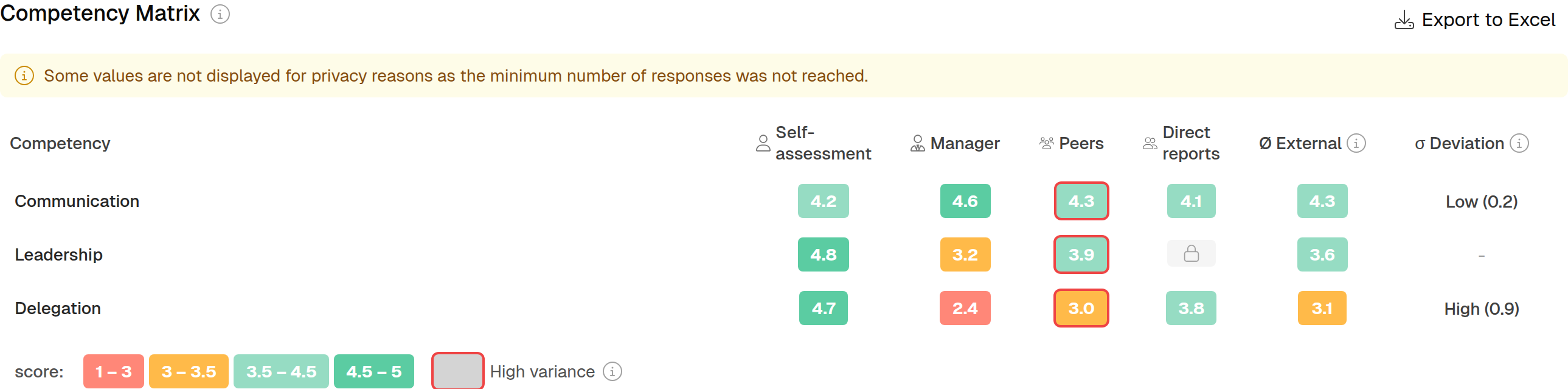
The Competency Matrix on your 360° feedback dashboard summarises a lot of individual ratings in just a few numbers. This article explains exactly what those numbers mean — how Ø External and σ Deviation are computed, what the ring around a cell stands for, and how anonymity affects the figures you see.
Please note:
- All scores in the matrix are shown on the questionnaire's scale (for example 1–5 or 1–10) and rounded to one decimal place.
- Ø External never includes your Self-assessment.
- σ Deviation is intentionally hidden whenever a perspective in that row is anonymity-restricted, so you never see a deviation calculated from an incomplete picture.
- Within-group deviation (the ring around a cell) is only calculated once a perspective has at least 6 distinct raters.
Each cell in the matrix represents one dimension (a competency) seen from one perspective (Self-assessment, Manager, Peers or Direct reports).
To compute it, Honestly:
- Takes every response from that perspective to a question that belongs to the dimension.
- Converts each response to a value on the questionnaire's scale. This step makes different question types — stars, smileys, NPS, ranked select — comparable.
- Averages those values.
- Rounds to one decimal place.
If anonymity removes a question (see below), only the remaining questions in the dimension are used. If anonymity removes every question of the dimension for that perspective, the cell stays blank.
Ø External — your overall external assessmentØ External is the arithmetic mean of the perspective averages, with your Self-assessment excluded.
Ø External = average of ( Manager score, Peers score, Direct reports score )
Two things are worth knowing about this number:
- Perspective groups count equally. A peer group of ten people contributes one number to Ø External, the same as a single manager. The cell value for each perspective has already averaged out the individual raters before it reaches this step.
- Anonymity-restricted perspectives are simply skipped. If, say, the Direct reports perspective falls below its anonymity threshold, Ø External is the mean of Manager and Peers only.
If no external perspective has a score, Ø External is blank for that row.
σ Deviation — how consistently you are perceivedσ Deviation measures how far apart the perspective scores in that row are. It is the standard deviation of all perspective scores, including your Self-assessment.
The figure is shown next to one of three labels:
| Label | Rule | Meaning |
|---|---|---|
| Low | σ is up to 10% of the scale range | Perspectives agree closely. You are perceived consistently across groups. |
| Medium | σ is between 10% and 20% of the scale range | Moderate differences between perspectives. |
| High | σ is above 20% of the scale range | Perspectives diverge clearly. Different groups experience you differently. |
On a 1–5 scale (range 4) this means: Low when σ ≤ 0.4, High when σ > 0.8. On a 1–10 scale (range 9): Low when σ ≤ 0.9, High when σ > 1.8.
σ Deviation is intentionally left blank when:
- Fewer than two perspectives have a score in that row, or
- Any perspective in that row is anonymity-restricted — even if the other three would be available. A deviation calculated from a partial set of perspectives would be misleading, so Honestly does not show one.
A High deviation is not automatically a problem; it simply tells you that different groups see you differently and that the row is worth a closer look.
The ring around a cell — agreement within the perspectiveWhile σ Deviation compares perspectives against each other, the ring around a cell tells you how much the raters inside one perspective disagreed with each other.
- The ring only appears when that perspective has at least 6 distinct raters. Below that, no ring is shown — not because everyone agreed, but because the group is too small for a reliable spread.
- The exact mean, the response count and the within-group deviation are shown in the cell's tooltip.
Anonymity is enforced per perspective, per question, by comparing the number of distinct raters to that perspective's threshold. The effects cascade through the matrix:
| What you see | When it happens |
|---|---|
| A cell shows – | Every question in that dimension for that perspective fell below the threshold. |
| Ø External is computed but excludes one or more perspectives | At least one non-self perspective is anonymity-restricted but another non-self perspective still has data. |
| Ø External is blank | No non-self perspective has data left. |
| σ Deviation is blank | Any perspective in that row is anonymity-restricted, or fewer than two perspectives have a score. |
| Yellow banner above the matrix | At least one cell in the matrix is anonymity-restricted. |
The rule of thumb: anonymity blanks a value, it never substitutes one.
Related articles- How do I read my 360° feedback results dashboard?
- How does anonymity work in 360° Feedback?
- What is 360° Feedback and how does it work?
- Who can see the results of a 360° feedback run?
If you have any questions, please do not hesitate to contact us.